Workplace Update – New York State HERO Act to Protect Worker’s from Airborne Diseases – New Policies to be Established

image_pdfimage_print

The New York Health and Essential Rights Act , also known as the New York HERO Act, is currently in effect. The New York HERO Act was passed in response to the Covid 19 pandemic. By August 5, 2021, all New York employers must establish policies and procedures to be distributed to their employees; posted in a well-viewed location; and to be followed when required.

According to the New York State Department of Labor “The airborne infectious disease exposure prevention plans must go into effect when an airborne infectious disease is designated by the New York State Commissioner of Health as a highly contagious communicable disease that presents a serious risk of harm to the public health.”

The New York State Department of Labor has set forth new Airborne Infectious Disease Exposure Prevention Standard, a Model Airborne Infectious Disease Exposure Prevention Plan, and various industry-specific model plans for the prevention of airborne infectious disease that employers can follow and utilize in creating their own policies to protect employees from airborne infectious diseases in the workplace.

The plan applies to all “employees” which has been defined to mean “any person providing labor or services for remuneration for a private entity or business within the state.” The term “employees” includes part-time employees, independent contractors, consultants, temporary and seasonal workers, domestic workers, home care and personal care workers, farmworkers, day laborers, individuals working for digital applications or platforms, staffing agencies, contractors/subcontractors on behalf of the employer at any individual work site, individuals delivering goods or transporting people on behalf of the employer. “Employees” as defined is without regard to the individual’s immigration status.

For more information on the New York HERO Act Airborne Infectious Disease Exposure Prevention Standard click here.

To view a copy of the New York HERO Act Model Airborne Infectious Disease Exposure Prevention Plan/template that sets forth the minimum standards employers are to implement click here.

The plan requires minimum controls to be put into place during an outbreak, including, without limitation: health screening, face coverings, physical distancing, stay at home policies for those with symptoms or who have been exposed, hand washing and sanitizing, disinfecting and cleaning by the employer. The plan also requires advanced controls be put into effect alongside the minimum controls when the minimum controls are not deemed sufficient. Some such controls, include the following, among others: ventilation systems, barriers such as partitions or plastic guards, additional PPE to be provided to employees at no cost to the employee, change in traffic flow, limiting the use of shared work stations, etc.

The new law also contains an anti-retaliation provisions to protect employees who exercise their rights under the law.

While employers are required to prepare and distribute the plans by August 5th, currently as of the date of this posting, they are not required to be put into effect.

For more information regarding your rights and obligations, contact Sheree Donath at sheree@donathlaw.com, (516) 804-0274 or by clicking here.

(Attorney Advertisement)

Many say that the “Great Resignation” is coming. Before you quickly resign, think about your options, what job values you seek, and what is your ideal job. Is resigning the best choice?

image_pdfimage_print

As Covid restrictions are lifted and employers require employees to return to the workplace, many employees are debating about whether they want to return to their current job or if they should resign and seek new employment. Many feel that they are on a merry go round that simply doesn’t stop turning and want to make a quick change.

While employees say they tired of the zoom/ teams/ google meets they are also concerned about commuting 1-2 hours each way on a daily basis. Employment during the pandemic has shown what jobs can be performed remotely and what roles need to be in person. Many employees are now faced with the choice of return to the office or resign. For those employees who have been able to work remotely, in some form, for the past 1.5+ years, some are deciding whether they are ready to transition back to the “normal” office.

For those considering whether to return to the office or to resign, we suggest making a pro/con list to determine the job values that are important to you and your family. We suggest that you rank your job priorities to help with your decision and to help you find your ideal job. This will assist you in deciding if the job you currently have is the right one for you or if it is time for a transition.

Some factors to consider are:

– In office experience/ Working from home/having the ability to work in a hybrid model

– Salary/ compensation/ commission

– Benefits (health, 401k, equity, etc.)

– Flexible work schedule

– the role you are being asked to perform vs. the role you thought or hoped to perform

– travel on behalf of the company and commuting

– childcare costs

– relation with your current Manager?

Keep in mind that resigning from your job without forth thought and/or new employment may not bring you 100% satisfaction. Many people often believe that it will be better somewhere else only to learn that isn’t the case and the same issues they had at their previous job exist at the new job.

If you are going to resign from your job, there are various factors to consider. For more information, click here.

To find out more about transitioning out of your current role and possibly seeking severance, click here.

For assistance in reviewing and negotiating the terms of your new employment, click here.

To schedule a consultation with Sheree Donath, Esq. click here or contact Sheree Donath at sheree@donathlaw.com.

(Attorney Advertising)

Important Employment Updates

image_pdfimage_print

Employers to cover 100% of COBRA costs for employees:

The American Rescue Plan Act (ARPA) was signed into law on March 11, 2021. ARPA contains regulations relating to COBRA and an employer’s responsibility to its employees.

Specifically, ARPA requires: Employers to cover 100% of the employee’s cost of continuing health coverage under COBRA for up to six months if an employee has lost health coverage due to (a) a reduction in force or (b) the employee was involuntarily terminated. Basically, an employee terminated for any reason, other than gross misconduct, will fall within this provision. The COBRA subsidy period covered by ARPA is from April 1, 2021 to September 30, 2021. It applies to all employees who are or would’ve been covered during this six month period. It is not applicable if an employee is entitled to any other health insurance coverage.

For more information regarding your rights to the COBRA subsidy or to find out if you are entitled to additional benefits from your company due to a recent termination and/or receipt of a severance package, contact Sheree Donath at sheree@donathlaw.com.

Employer’s are required to give employees PAID time off to get the Covid-19 vaccine:

New York employers are required to provide employees time off to get a Covid-19 vaccination. This requirement became effective on March 13, 2021 and currently runs through December 31, 2022. The vaccination leave law applies to all private employers regardless of their size.

Per the new vaccination leave law:

  •  entitles employees to paid time off of up to four (4) hours for each vaccine injection. Employees are entitled to paid time off of up to four (4) hours for each dose of the vaccine they receive (i.e. so if the employee gets a Covid-19 vaccine that requires two doses and the employee has to go twice to be vaccinated, they are entitled to up to eight (8) hours of paid time off).
  • prohibits employers from requiring employees to use PTO or sick leave or any other leave
  • requires that employees be paid their regular rate of pay.
  • doesn’t affect rights under a collective bargaining agreement that may allow for additional time off.
  • prohibits employers from discriminating or retaliating against employees for exercising their rights under the vaccination law.

For more information regarding the vaccination law or updating employment policies, contact Sheree Donath at sheree@donathlaw.com or by clicking here.

Coming Soon  … legalizing recreational marijuana in New York’s effect on the workplace.

 (Attorney Advertising)

My Employer Gave Me a Performance Improvement Plan. Is this an Uphill Battle That I Can Achieve or am I Going to be Fired Anyway?

image_pdfimage_print

Performance Improvement Plans, also known as a P.I.P or an action plan, are sometimes used to help employees improve their performance but are often used by employers as a means to terminate employees. They are a written record of the employee’s alleged deficiencies.

A performance improvement plan requires that the employee meet certain expectations within a 30, 60 or 90 day period. The expectations are ones that usually cannot be achieved in this short period of time and ones that come as a surprise to the employee receiving the plan.

A performance improvement plan generally comes after a performance review. The employee is left with a sense of confusion of how can I make the situation better, if at all. The employee struggles with what their options are and how to proceed.

A lowered performance review and/or receipt of a performance improvement plan is done to force the employee to make a decision. Fight to keep their job and achieve the seemingly unachievable goals, or resign from their job and lose out on benefits, unemployment and/or vesting. Employees often wonder whether they should quit or work through the performance plan.

Employees should take action upon receipt of the performance improvement plan and should respond to the plan, in writing. The performance plan should be reviewed to see if it violates any contracts, policies or company practices. The plan should be compared to the employee’s job description to see if the plan requirements are outside the parameters of the job. It should be determined whether the employee received any prior warnings. Whether there was a change in management that sparked the lower performance rating or performance plan. Or, among others, whether the employee is being placed on the plan for an improper or illegal reason.

If you have received a performance improvement plan or a poor performance review, you have options and you should take action to determine how to proceed.

EMPLOYEES CAN TAKE ACTION WHILE THEY ARE STILL EMPLOYED AND DO NOT HAVE TO WAIT UNTIL THEY ARE FIRED OR FORCED TO RESIGN!

For more information about your options contact Sheree Donath to schedule a consultation.

(Attorney Advertisement)

Time for a Divorce? Divorce Mediation is the Best Choice. See why it is Successful …

image_pdfimage_print

Divorce mediation is recommended because it is quicker, cheaper and a more flexible process. It is highly encouraged if there are children involved. Divorce mediation protects the children from being dragged through a long, contentious process. Mediation is a non-binding process, that can be terminated by either party at any point during the process. The mediator helps facilitate the parties coming to agreement on important terms.

In order for mediation to be successful, both parties have to want (or at least be willing) to be part of the process. There cannot be an imbalance of power. Both parties must be able and willing to speak up and participate.

In our mediation sessions, when there are children involved, the first point for discussion is the parenting plan. I have found that if the parties cannot first come to terms on the issues relating to the children, then the mediation often isn’t successful. In discussing the parenting plan, we discuss who has custody, where the children will live, can the parties relocate, how time is shared on holidays and vacations, what happens if schools close for remote learning, etc.

During the mediation we will discuss distribution of all assets and liabilities, including what kind of debts do the parties have? Who is responsible? Who will pay them going forward?

We will discuss maintenance (formerly referred to as alimony), child support and add-on expenses. The parties will discuss the formulas associated with calculating these amounts and decide if they want to negotiate and modify these amounts.

Other matters discussed include without limitation: distribution of money in bank accounts, stocks, bonds, bonuses, deferred comp., etc. There is discussion about health insurance – who has it and who will be responsible for maintaining it going forward. There is discussion about real estate and how any equity may be distributed. We also discuss distribution of retirement monies, i.e. pensions, 401K, 403b, etc. and life insurance – whether the parties have it or need to get it, as well as what happens should one or both of the parents pass away.

The mediation process ends when the parties come to agreement on all open issues. An agreement is prepared and the parties sign this agreement in front of a notary public. The parties are encouraged to have the agreement reviewed by their own attorneys so that they understand what they are legally entitled to and what they may be giving up. Signing the agreement, does not mean that the parties are divorced. The agreement is a contract that is enforceable in court. The agreement must be submitted to the Court (along with approximately 10-15 other documents as part of an uncontested divorce) for Court approval to obtain a divorce.

If you are considering the mediation process and want to see if you are a good candidate for this process, click here to see if mediation is the right option for you.

Presently many divorce mediation sessions are being done virtually. For more information about a virtual divorce mediation, click here.

If you are interested in moving forward with mediation, check out the checklists we have prepared at www.donathlaw.com. These checklists will help you prepare for your mediation and provide some insight on the documents you need to gather to be prepared for your mediation.

For more information, contact Sheree Donath at sheree@donathlaw.com or at 516-804-0274 or by clicking here.

(Attorney Advertising)

Happy New Year from Donath Law, LLC

image_pdfimage_print

May 2021 bring you, your family and friends health, happiness, prosperity and everything you have been dreaming about this past year.

As you embrace this new year, consider what will make you happy and how to accomplish that goal.

If you are thinking about changes in your employment or your marriage, start this new year right, and contact Donath Law, LLC to find out your rights and options.

After a long year, let’s remember that we still have some control over our destiny. Let’s together make 2021 the best it can be.

(Attorney Advertising)

The EEOC Offers New Guidance Regarding Vaccines in the Workplace

image_pdfimage_print

The EEOC has been offering continuing guidance about discrimination laws in the workplace and how they relate to the current pandemic.

Yesterday, they updated their frequently asked questions to include a section on the new vaccine and requiring vaccinations.

Click on this link for more information and to read the frequently asked questions and response from the EEOC.

If you have questions or concerns regarding your employment, contact Sheree Donath at 516-804-0274 or sheree@donathlaw.com to find out your rights and options.

(Attorney Advertising)

New York State Paid Sick Leave – Links to Help You Understand the New Law and How it Applies

image_pdfimage_print

New York State Paid Sick Leave Law went into effect on September 30, 2020. To find out more about this new law and how it applies to you, click here.

For New York State Paid Sick Leave details, click here.

For guidance on the new law and to find answers to common questions, check out the New York State Department of Labor’s Frequently Asked Questions, by clicking here.

New York City also amended its sick leave law to comply with the new state law. For more information on application of New York City’s Safe and Sick Leave law, click here.

(Attorney advertising)

My Severance Package Has a Non-Disparagement Clause – Is that Common?

image_pdfimage_print

Employees who are terminated from their employment may be offered a severance or separation package. Aside from the monetary component of the severance offer, there are various legal provisions that the employee is asked to agree to in order to receive the payment(s) that are being offered. One common provision found in a severance package is the non-disparagement clause.

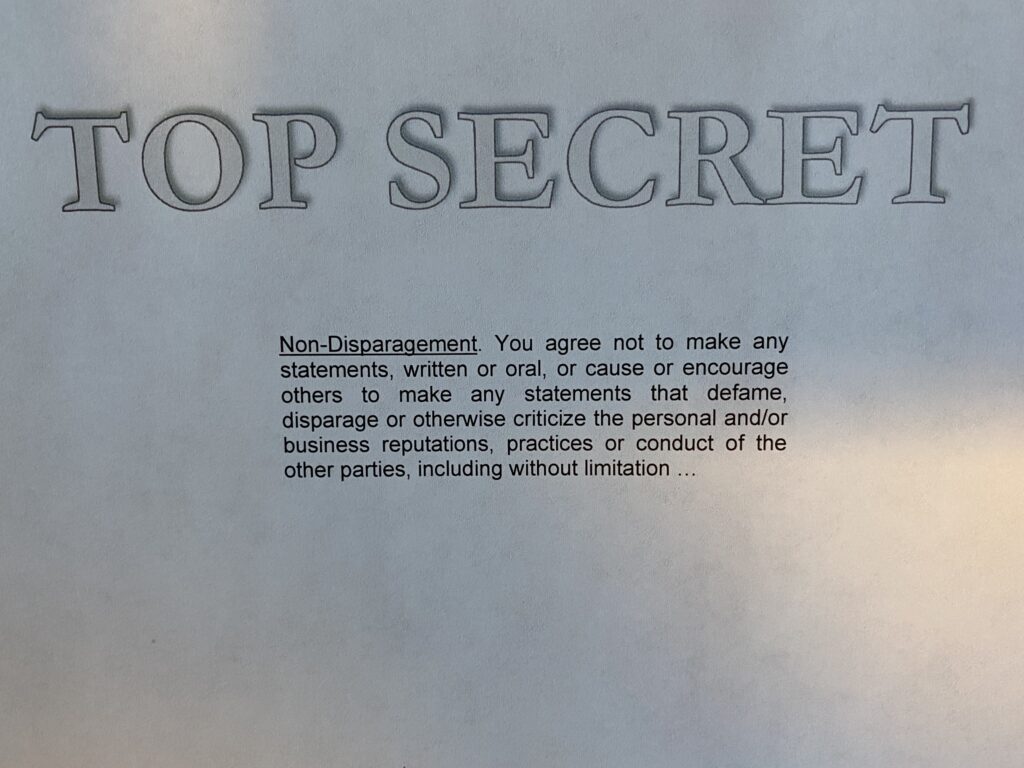
Non-disparagement clauses generally seek to protect the company from the current or former employee stating anything negative about the company, its officers and its employees. They can be found in severance documentation and/or in employment agreements.

An example of a standard non-disparagement clause is the employee agrees not to make any statements, written or oral, or cause or encourage others to make any statements that defame, disparage or otherwise criticize the personal and/or business reputations, practices or conduct of the employer, officers, employees, affiliates, and/or the products and services of the employer.

Non-disparagement clauses can be more detailed, stating specifically, that the employee may not say anything negative or that may result in any harm to the business. Such statements cannot be verbal or be to the media, on social media, in writing, or in any future publications, among others.

Rarely, are departing employees offered mutual non-disparagement clauses. Employers are generally concerned about providing a mutual non-disparagement clause because depending on the size of the employer it may be difficult for the company to control the remaining employees and former employees of the business.

However, like all other components of a severance package, severance is a business exchange, the employer is seeking to buy something from the employee and in exchange have the employee agree to some limitations (i.e. release of claims, confidentiality, non-disparagement). Thus, employees have rights and should have the agreement reviewed and possibly negotiated so that the employee understands what they are signing, what they are giving up and what they may be receiving and possibly receive their own non-disparagement protections.

Severance and new employment documents should be reviewed before signing them so that the employee understands the legal terms within. For more information on why a severance package should be reviewed, click here.

To find out what terms generally appear in a severance package, click here.

To understand whether terms in the severance agreement can be negotiated and what items can be requested, click here.

If you received severance or separation documents that you would like reviewed and to determine if the offer within can be enhanced, contact Sheree Donath by clicking here or at sheree@donathlaw.com or at (516) 804-0274.

(Attorney Advertisement)

Is your Parenting Plan back to school ready?

image_pdfimage_print

Schools are reopening and are operating with new changes in the classroom and virtually. Parents must adapt and ready to navigate this new and fluid environment. Aside from preparing for the unknown school year, parents going through a divorce should consider how the changing environment and new way of school will effect their parenting time with their child(ren). Even parents who have parenting plans in place already may want to modify these plans to update them to include terms related specifically to their child(ren)’s daily education.

The following thoughts may be helpful to include in any new or updated divorce agreements and parenting plans:

(1) Whether one or both parents will make the decision if the child(ren) attend school in person or virtually and if optional, for how many days per week. And whether the decision is one for a short period of time or will continue for the entire school year.

(2) If virtual learning, will one or both parents be responsible for/ present to assist with the child(ren)’s learning/ education? (i.e. help them log in online; make sure they understand, do and submit the assignments; etc.)

(3) Will one or both parents be responsible for assisting with homework?

(4) Will one or both parents be able to work from home should the child(ren) have to quarantine or if the school closes? Or will one or both parents hire someone to assist with the child(ren)’s schooling at home while the parents are at work? Will that be someone from the family or will it be an additional cost and if paying the person, which parent or both will be responsible for any additional costs.

(5) Will one or both parents make the decision to change the child(ren) from in school learning to virtual learning? And if virtual learning, will that be for the whole school year or a quarter? Or how often will the decision be considered or changed? Does the child(ren) have any input into the decision?

(6) Will the child(ren) be able to see both parents if the child(ren) or parent(s) are sick or have been exposed to the coronavirus?

(7) Will the child(ren) be able to attend college? Rent an apartment? Stay in a dorm? Will the parents agree to pay the same tuition if online learning at a university rather than in person learning at a college?

While there are a multitude of questions and unknowns in the current pandemic, some issues can be mapped out for the parents and the children so that there are a few less levels of mystery and anxiety for the parents and the children.

Click on this link to review other items of consideration in preparing a parenting plan.

Parties willing to discuss and resolve these issues can do so with the help of a mediator. If you seek assistance with preparing or modifying your Parenting Plans, contact Sheree Donath at 516-804-0274 or sheree@donathlaw.com or by clicking here.

(Attorney Advertisement)